Biomanufacturing Air Systems for Cell Therapy
23rd Feb•9 min read
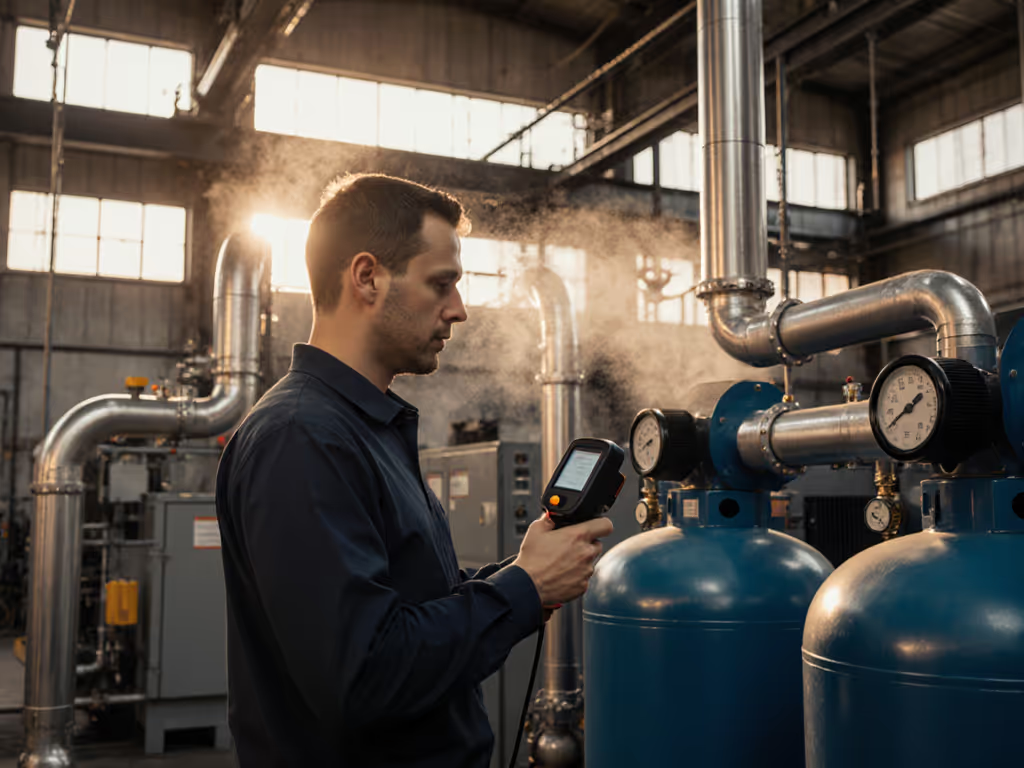
A compressed air system audit isn't a luxury, it's a financial necessity. For a broader efficiency plan beyond auditing, see our guide to optimizing compressed air systems. Most shops waste between 25% and 50% of their compressed air energy through leaks, pressure drops, and duty cycle misalignment, often without realizing it. An audit forces the numbers out of hiding and reveals where your money is actually going.
Most operators fall into a trap: they buy a compressor based on nameplate horsepower and stated SCFM, then watch it run all day even when tools sit idle. Energy waste identification begins the moment you ask a simple question: Is the system actually loaded most of the time, or is it running at full power with minimal demand?
Here's where the math gets real. A 5-horsepower two-stage rotary screw compressor draws approximately 18-22 amps at full load under optimal conditions. But nameplate horsepower doesn't tell you the duty cycle truth. If that same unit sits spinning unloaded for 12 hours per day (a common scenario in small shops), you're bleeding money into atmospheric air release and motor heating. An unloaded rotary screw still consumes 30-40% of its full-load amperage just to operate its inlet valve and cooling fan.
I once consulted on a small cabinet shop that bought a used rotary screw at a steep discount. The owner thought he'd solved his air supply problem cheaply. After six months, the monthly electric bill hadn't budged, in fact, it climbed slightly. The compressor was right-sized for peak demand but ran unloaded most hours. Once we logged actual demand patterns and duty cycles, then paired that worn unit with a proper two-stage system running auto-shutoff and nighttime idle termination, the electric bill dropped 35% and uptime climbed. The payback landed in ten months. That's the payoff of an audit: proof that duty cycle is destiny.
Two main approaches exist: pressure drop analysis via spot checks, or multi-day continuous logging with data acquisition. Each reveals different truths.
Manual demand profiling techniques involve measuring pressure, flow, and amperage at key points during a typical shift:
Cost and Turnaround: Usually one to two hours on-site. Low investment; high bias risk if the day observed isn't representative.
What it reveals: Whether your current system can barely keep up, or whether it's oversized and wasteful. You'll see system efficiency metrics like recovery curves and pressure stability.
Limitation: You're watching a snapshot, not the full week. If you audit on Tuesday but the heaviest production happens Friday, you miss the real constraint.
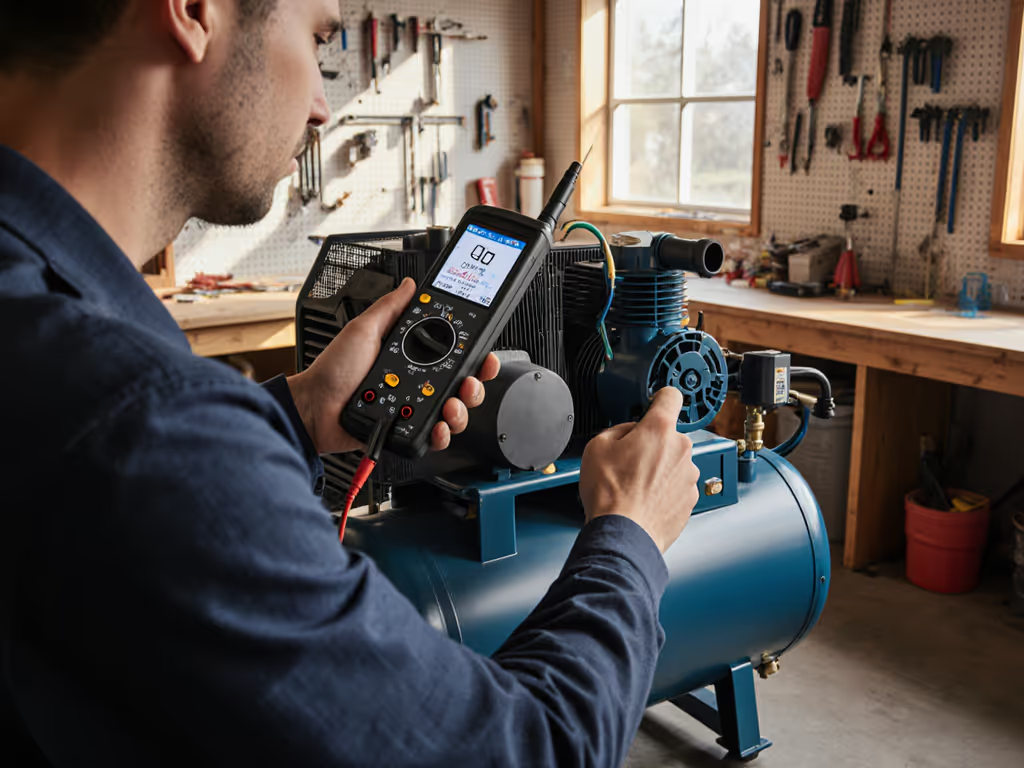
Continuous monitoring captures pressure, amperage, and flow across several days or weeks using affordable data loggers (often under $300). Modern portable units record:
Cost and Turnaround: $300-600 in equipment; 5-7 business days of logging; analysis another 1-2 hours.
What it reveals: True duty cycle, hidden waste patterns, and repeatable cost per hour of operation. You see when leaks happen (pressure drops overnight), how fast the system responds to demand spikes, and whether peak demand exceeds your design margin.
Advantage: This data is reproducible, defensible, and actionable. You can model "what if" scenarios (e.g., "If we fix that 18-CFM leak and add auto-shutoff, we save $X per year").
Once you're logging data, you'll find waste hiding in four places:
A 1/8-inch hole at 90 PSI bleeds 8-12 CFM of compressed air into thin air. One 3/16-inch leak? 30 CFM gone. Most shops tolerate 10-15% leakage because they assume it's "normal." It's not.
How to identify: Walk the system with soapy water while running. Mark every weeping fitting, cracked hose, and failed quick-connect seal. Log the pressure drop at night when no tools run (if pressure falls more than 5 PSI in 8 hours, you have a significant leak). To choose the right detection method, see our comparison of ultrasonic vs thermal leak detection.
Cost impact: A 20-CFM continuous leak costs roughly $4,500–$6,000 per year in wasted electricity (assuming 40-hour weeks and typical motor efficiency).
Undersized hose, long runs, restrictive filters, and poorly placed regulators steal working pressure. If your tank holds 100 PSI but your tool only sees 85 PSI, that's a 15 PSI penalty that steals usable flow.
How to measure: Place pressure gauges at the compressor tank outlet and at the tool inlet. Run a heavy load (e.g., HVLP spray gun or die grinder). The difference is your pressure drop analysis result. Ideal: no more than 10% of working pressure (typically 9 PSI if you're targeting 90 PSI).
Cost impact: Every 1 PSI drop costs roughly 2-3% in motor efficiency. A 15 PSI drop translates to 30-45% more energy draw than necessary to maintain working pressure.
The compressor starts unloaded (inlet valve closes, motor idles), then transitions to loaded once pressure falls below a threshold. If that unloaded idle lasts 20 minutes between tool pulls, you're paying for air you're not using.
How to detect: Check amperage draw when the inlet valve closes. Full-load two-stage units draw 18-22 amps; unloaded they drop to 5-8 amps. If the compressor idles unloaded for 40% of total run-time, that's dead cost.
Solution: Auto-shutoff (compressor stops entirely if idle for 15 minutes) or nighttime shutoff. If idle times vary widely, a VSD vs fixed-speed comparison can help decide whether variable speed control will curb unload losses. Cost to add: $200-400. Annual savings: $1,500-2,500 for a typical 5-HP unit.
Buying a compressor rated for peak demand, even if peak only happens 2% of the day, means paying full-load energy cost for mostly unloaded runtime. A 10-HP unit sized for a five-minute spike will waste money for eight hours.
How to measure: Tally actual tool demand (demand profiling techniques). Add up CFM requirements for all tools running simultaneously, normalize to working pressure (90 PSI, not 125), then add 25% headroom. That's your target compressor size. Compare to what you actually own. Then apply our air compressor sizing guide to validate capacity and avoid oversizing.
Audit outcome: If audit shows you're oversized by more than 30%, you might retire the large unit and add a smaller, more efficient complement, or add smart scheduling to reduce simultaneous loads.
Consider two small shops, each running similar tools (impact wrenches, angle grinders, HVLP sprayers):
| Metric | Shop A (Pre-Audit) | Shop A (Post-Audit) | Shop B (No Audit) |
|---|---|---|---|
| Compressor Type | 7.5-HP rotary | 5-HP two-stage + auto-shutoff | 7.5-HP rotary |
| Unload Time | 35% of operating hours | 8% of operating hours | 35% of operating hours |
| Pressure Drop | 18 PSI tank to tool | 8 PSI tank to tool | 18 PSI tank to tool |
| Annual Electric Cost | $7,200 | $4,100 | $7,200 |
| Audit Investment | $500 | - | $0 |
| Payback Period | 5 months | (baseline) | Never runs audit |
Shop A invested $500 and five days of data logging. The audit revealed that upgrading to a correctly sized two-stage with auto-shutoff and fixing the hose run would cut energy costs by 43% ($3,100 per year). Shop B never looked. Over five years, that's $15,500 in avoidable waste.
Pay once for uptime, not forever for waste and noise.
An audit isn't just about energy waste, it reveals maintenance burden and its hidden cost. When you log unload time, pressure swings, and temperature trends, you also learn:
Each fix rolls into your true cost-of-ownership model. Yes, adding a $500 auto-drain and soft-start is an upfront expense, but it reduces annual energy waste by $1,500 and extends compressor life by 3-5 years. That's a 2.3-year payback, a net win.
A compressed air system audit pays for itself in months, not years. The process is straightforward: measure actual demand, log energy draw, identify leaks and pressure losses, then model the cost of fixes. Shops that do this once cut energy waste by 25–45% and eliminate the "I thought my compressor was undersized" guessing game.
Start here:
The system that meets spec for years with minimal waste is not the cheapest one upfront, it's the one you've measured, understood, and tuned. That's the only system worth owning.