Moisture Analysis Comparison: Dew Point Accuracy
6th May•10 min read
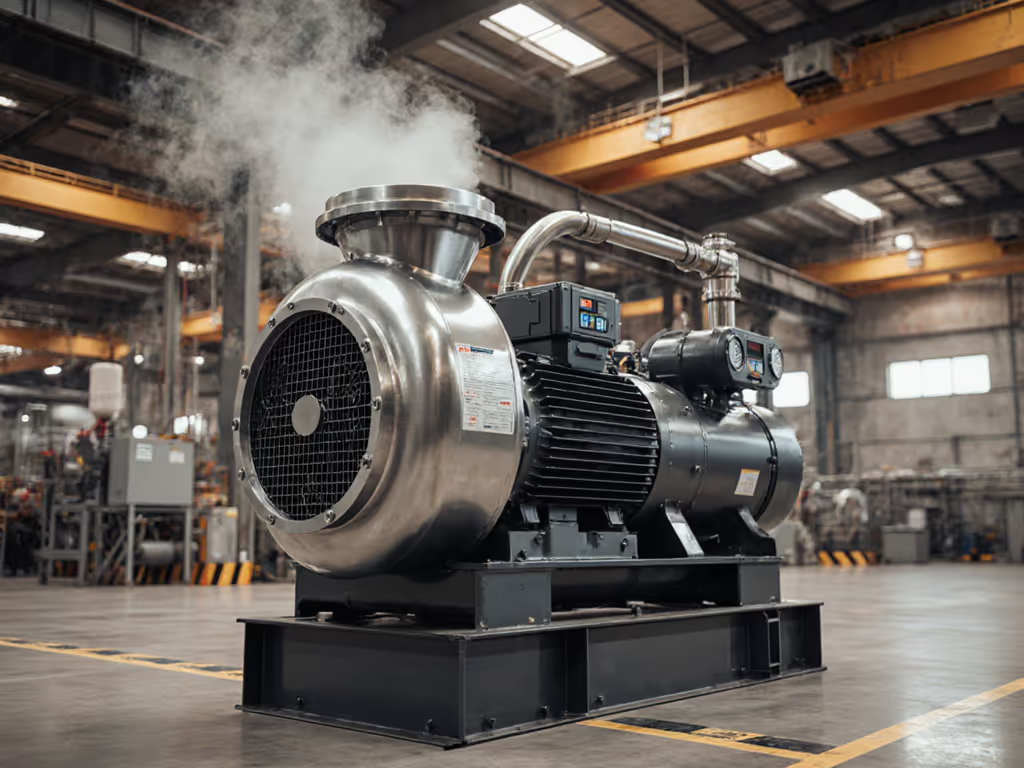
Centrifugal air compressors operate on principles fundamentally different from their rotary screw counterparts, and understanding those differences is critical before sizing a system for your shop or mobile operation. The sales literature might tout impressive cubic-foot-per-minute (CFM) numbers, but without context on pressure, duty cycle, and real-world testing conditions, those figures are essentially marketing abstractions. This deep dive addresses the questions that matter: How do centrifugal air compressors compare to alternatives on actual delivered performance? What efficiency gains are real, and which are hype? And when does the upgrade justify the investment?
Centrifugal air compressors achieve their efficiency advantage through multi-stage compression efficiency (a design that compresses air in sequential stages, with each stage reducing turbulence and improving heat transfer between stages).[1][3] The machine converts rotational energy into pressure energy more effectively than single-stage alternatives.
The key differentiator is how impellers and diffuser plates work in tandem. Rather than relying on meshing rotors (as screw compressors do), centrifugal units accelerate incoming air with rotating disks, then use diffuser geometry to convert that velocity into pressure.[3] At working pressure (and here's where the story gets honest), a properly configured centrifugal compressor doesn't simply meet rated CFM. It sustains it across varying load conditions.
Modern designs add another layer: variable inlet guide vanes. These vanes sit close to the first-stage impeller and impart beneficial "swirl" to the incoming air, reducing turbulence and improving energy efficiency by up to 8 percent compared to fixed butterfly valves.[2] The result is a machine that performs at part load without efficiency collapse, something earlier designs struggled with.
Industrial data confirms the advantage: centrifugal compressors qualify for energy rebate programs from local utilities, with documented savings in excess of $100,000 in some cases.[2] That's not theoretical. That's measured against baseline consumption in real facilities.
This is where many installations fail, and it's worth addressing directly. A contractor once dropped off two compressors, both labeled "5 CFM," to support a pneumatic DA sander. On the bench, one delivered 3.2 CFM at 90 psi, the working pressure that tool actually needs to perform. The other hit 4.8 CFM at the same pressure. The culprit wasn't brand reputation; it was undersized quick-connects and a restrictive regulator upstream. We upsized the fittings, and uptime jumped.
The lesson is this: Show me CFM at 90 psi, not brochures. Free-air CFM (SCFM at ambient pressure) tells you almost nothing about what your tools will receive. For a plain-English breakdown of how CFM relates to pressure at the tool, see our CFM vs PSI guide. At working pressure, here's the story: centrifugal compressors maintain their advantage because multi-stage compression efficiency keeps velocity losses lower across the full system.[1][4]
To evaluate a centrifugal system properly, demand:
Without these data, you're guessing. And guessing leads to starving tools, failed installs, and the cost of replacement.
Early centrifugal compressors topped out at 10 to 20 percent flow turndown, meaning if demand dropped, the machine either surged (became unstable) or wasted energy through blow-off valves. Modern designs flip that limitation.[2]
Variable inlet guide vanes combined with fast microprocessor controllers allow turndown up to 50 percent or greater.[2] This flexibility matters directly to your bottom line: if your workflow has variable demand (some hours spraying, others idle), the compressor doesn't blow off excess air during light-load periods. It modulates down and saves energy. Conversely, when demand spikes, it ramps up without lag.
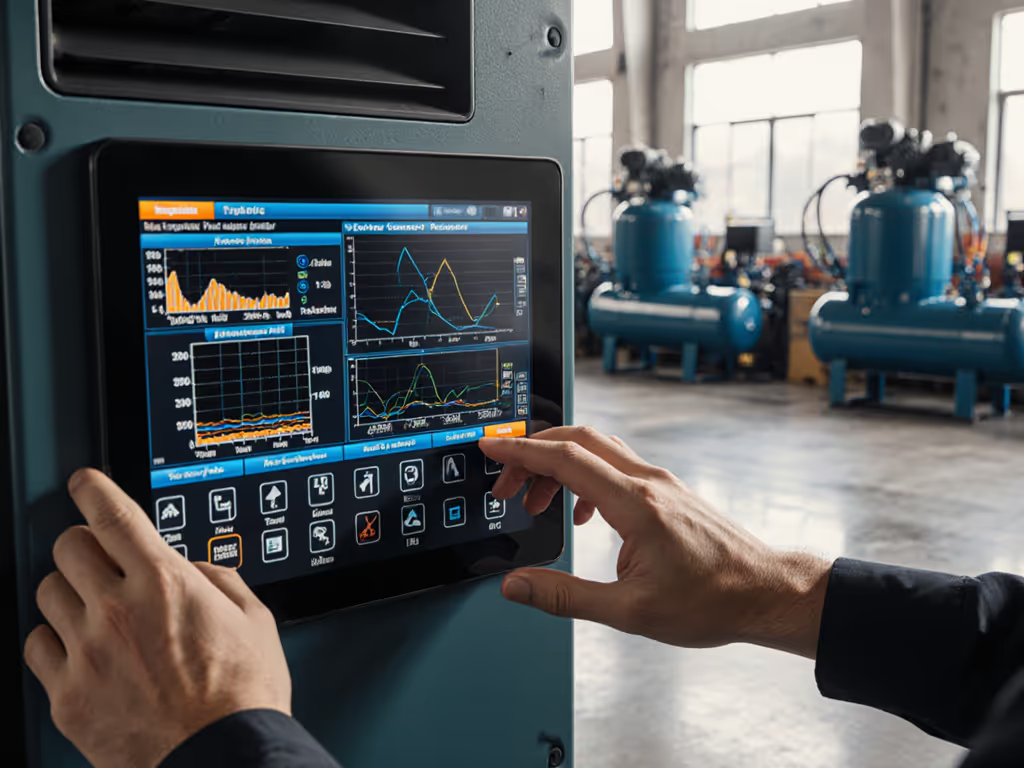
The control architecture is critical. Multiloop microprocessor systems orchestrate pressure relief, unloader functions, and inlet modulation simultaneously. For a deeper look at control strategies and monitoring, compare smart compressor control systems. Computer-aided impeller design optimizes blade geometry for efficiency across the entire operating envelope, not just peak flow.[2]
The practical outcome: Surge control technologies and inlet modulation eliminate the efficiency cliff. You can install a high-capacity centrifugal into a system with unpredictable demand and trust it to hold pressure and supply consistently. That reliability translates directly to reduced downtime and operator frustration.
Here's what the data shows: centrifugal compressors operate continuously for two years between basic maintenance shutdowns, a span that dwarfs rotary screw intervals.[2] Plan upkeep proactively with our air compressor maintenance schedule by type. Over a 40 to 60 year service life (compared to 20 to 30 years for screw machines), that's compounded uptime.[2][5]
Why? Turbo compressor reliability stems from design elegance: most internal components are non-contacting.[2] There's no mesh wear, no filter-clogged rotors, no oil degradation cycles to chase. Maintenance checklist:
That's it. No oil changes (centrifugal compressors are oil-free by design), no seal replacements every 18 months, no belt tension adjustments. The absence of oil in contact with compressed air also eliminates downstream contamination, a major advantage if your facility requires clean air for sensitive processes or if you're moving away from oil-flooded systems for sustainability reasons.[2]
Oil-flooded screw compressors consume upwards of 55 gallons of oil every 6 to 12 months; oil-contaminated condensate requires proper disposal.[2] Centrifugal units produce Class 0 oil-free air with condensate that may even be recycled.[2] Over time, that's massive cost savings in consumables and environmental liability.
Large industrial air compressors are the sweet spot for centrifugal technology. The machines scale from 300 HP to 30,000 HP, a range that makes a typical oil-flooded unit's 600 HP ceiling look modest.[5] Multi-stage, integrally geared designs can cover applications from automotive to steel, glass, food and beverage, air separation, chemical processing, and petroleum refining.[2]
Capacity isn't the only asset. Compactness matters too. A single large centrifugal can replace multiple smaller units while occupying less floor space.[3] For operations planning capacity expansion or retrofit upgrades, that footprint efficiency is real money saved on facility infrastructure.
Initial cost per horsepower decreases with compressor size, so the economics of scaling up improve.[6] That said, centrifugals do carry a higher upfront investment and specialized maintenance requirements compared to reciprocating or smaller screw units.[6] The payoff emerges over years of operation through energy savings, extended lifespan, and reduced downtime.
The threshold is typically 500 HP or more of continuous demand.[5] Below that, the efficiency and cost benefits often don't justify the capital outlay. Above it (especially if your baseline load is steady or your industry qualifies for energy rebates), a centrifugal system becomes economically rational within 5 to 7 years through energy cost recovery alone.
Ask yourself:
If the answer to most of those is yes, centrifugal compression warrants a deeper evaluation.
Centrifugal compressors in the 500+ HP range require three-phase power, 460V or higher (or 380V internationally). The soft-start motor controllers now common in modern units reduce inrush current compared to across-the-line starters, but this is industrial grade equipment. You're not running it on a 120V circuit or typical shop panel.[5]
Installation requires:
Upfront installation cost is real. But it's part of the total cost of ownership, not a reason to downsize into an undersized machine that will fail to meet demand.
The numbers support it, especially in medium-to-large industrial settings. Energy efficiency gains, combined with minimal maintenance requirements and a 40 to 60 year service life, create a compelling total-cost-of-ownership advantage over time.[2][5] Get the full picture with our 10-year total cost of ownership analysis.
A facility replacing multiple 100 to 150 HP rotary screw compressors with a single 500 HP centrifugal may see:
Over 20 years, those savings compound. The initial capital premium (often 20 to 40 percent higher than a comparable-capacity screw system) is recovered. Beyond breakeven, the facility accrues pure operational benefit.
If your operation's demand profile and facility infrastructure align with centrifugal compression, the next steps are deliberate and methodical.
Conduct a detailed air demand audit. Map your actual CFM consumption at working pressure across your typical load profile. Don't rely on stated tool CFM; measure real draw. Test equipment exists for this (manometers, flow meters, data loggers). The investment in accurate baseline data prevents oversizing or undersizing errors downstream.
Request independent performance data. Reach out to compressor vendors and ask for third-party or in-house bench test results showing CFM at multiple pressures, duty cycle under real load, amperage draw, and noise output under specified test conditions. If a vendor won't provide this, that's a red flag. Credible manufacturers have it.
Evaluate site readiness. Electrical capacity, foundation, vibration isolation, ventilation, and condensate management all need assessment before purchase. An installation that shortcuts these details will underperform, regardless of compressor quality.
Plan for scalability. If your facility anticipates growth, size the initial compressor with 15 to 25 percent headroom. Centrifugal units' turndown flexibility means running at part load won't hurt efficiency, but starving for air under peak demand absolutely will.
Consider aftermarket components. Even oil-free compressors benefit from downstream filtration, drying, and pressure regulation tuning. Invest in quality manifolds, regulators, and sensors to maximize system responsiveness and product quality downstream.
The data is clear: when conditions align, centrifugal air compressors deliver efficiency, reliability, and uptime that justify their cost. The key is matching the machine to your actual demand, at working pressure, with honest performance data in hand.