Wearable Medical Compressors: 25% CAGR Forecast
3rd Mar•10 min read
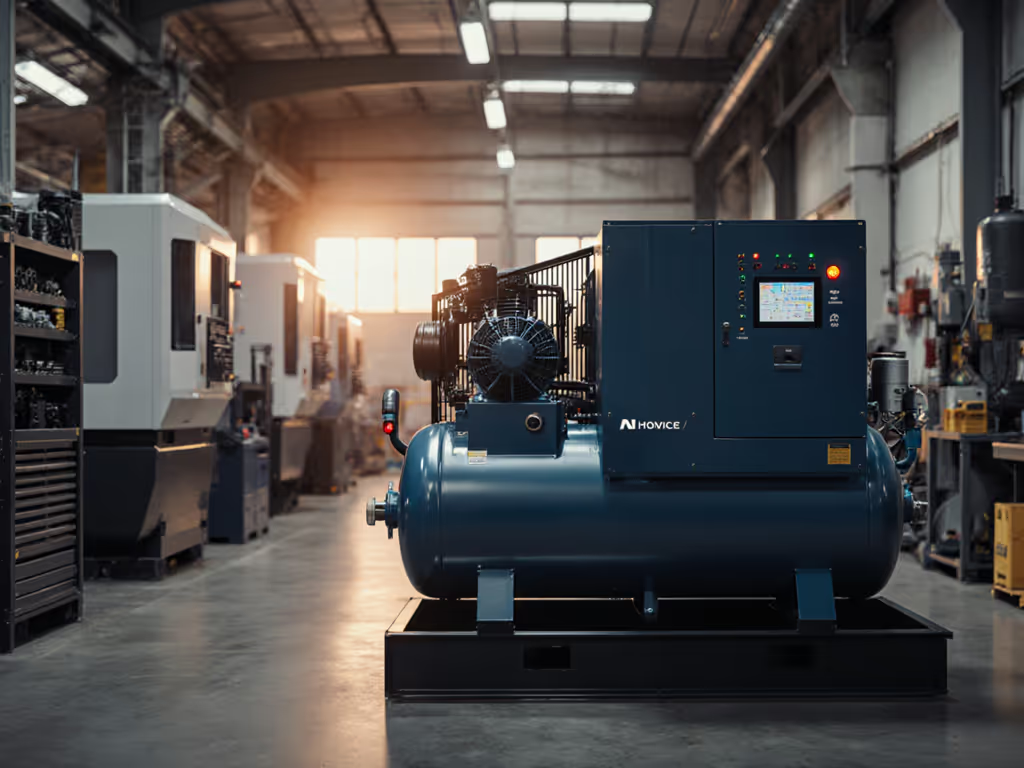
For small manufacturers and trade professionals, the question isn't whether compressed air matters, it's how to afford reliable supply without the capital shock of ownership. Small manufacturer CAS ROI calculations have shifted dramatically as compressor subscription economics reshape how facilities think about air systems. Rather than viewing a compressor as a capital asset you own and maintain for a decade, subscription-based service contracts transfer uncertainty to predictable monthly costs while keeping efficiency and uptime at the center.
The shift mirrors a larger trend in industrial equipment: predictability beats ownership when the math favors it.
A compressor subscription is a service agreement in which a provider installs, maintains, monitors, and replaces compressed air equipment at your facility. You pay a monthly or quarterly fee rather than a lump sum. Ownership stays with the provider; you gain access to air supply.
Traditional ownership requires you to:
Subscription flips this. The provider assumes responsibility for reliability. You pay for the service, not the machine. For small manufacturers operating on tight margins, this distinction is profound.
With capital expenditure reduction at the core, subscription ROI is measured differently:
Capital Purchase ROI:
Traditional payback period = (Equipment Cost + Installation) ÷ Annual Savings
Example: A $25,000 new compressor with $4,000 annual energy savings yields a 6.25-year payback. You only "profit" if the unit lasts beyond that window and you account for maintenance cost avoidance.
Subscription ROI:
Comparison = (Cost of Old System's Operational Expenses) − (Cost of Subscription + Baseline Service) = Net Annual Savings
Older compressors or unreliable multi-unit rigs often cost $8,000 to $15,000 per year in energy, maintenance, and downtime. A fixed subscription fee of $3,000 to $6,000 per year (covering a modern, efficient unit plus proactive maintenance) delivers immediate, measurable savings.[1][2]
Larger benefit: you break even in months, not years.
Energy consumption is the submerged part of the iceberg. Across industrial and small-shop applications, energy typically represents 70 to 80% of the total cost of ownership over a unit's lifetime, a fact confirmed by lifecycle cost analyses in the sector.[2][3] Maintenance and consumables (oil, filters, belts) account for another 12 to 15%. The purchase price? Only 10 to 20% of the true cost.[2]
This means:
Concrete example: A 75 kW fixed-speed baseline compressor running 6,000 hours annually at 70% average load costs approximately $67,500 per year in energy (at $0.15/kWh). The same nominal capacity with modern VFD efficiency drops to $49,200 annually, an $18,300 first-year difference. Over five years, that is $91,500 in cumulative savings, often enough to cover the entire subscription contract and then some.[3]
Subscription models lock you into modern, monitored equipment. You do not carry the energy penalty of aging machinery.
Small shops cannot afford compressor downtime. A paint booth starved of air, a nailer that stutters, or an HVAC system that loses pressure means lost revenue, missed deadlines, and frustrated crews.
Predictable operational costs emerge as a core value of subscription agreements. The provider maintains the equipment on a schedule (no surprise oil changes, no failed filters killing your day, no emergency service calls at premium rates).
Typical hidden costs of ownership include:
Under subscription, these are absorbed into the monthly fee. A facility manager knows exactly what the air supply costs and can budget accordingly. Risk transfers to the provider, who must keep the unit running or face service penalties.[1] For a financial perspective on service tiers, see our maintenance contracts ROI guide.
Service contracts bundled with subscription air supply reshape payback math:
Fixed Monthly Cost = Air Supply + Preventive Maintenance + Monitoring + Emergency Response
Most contracts run 36 to 60 months. Explore how small business compressor subscriptions deliver predictable costs and ROI. Over that span, a small facility avoids:
Payback is immediate and cumulative. Year one, you save the cost of proactive care you would otherwise defer. Year two, you avoid the first breakdown. By year three, you have recouped the subscription premium through avoided capital repairs and downtime.
For manufacturers with tight cash flow, the elimination of lumpy, unpredictable maintenance bills is itself an ROI.
A subscription approach decouples your air capacity from your capital availability. Need more airflow as you add spray booths or precision pneumatic tools? The provider upgrades the compressor or adds a sister unit (no new $40,000 purchase decision). You absorb the additional flow into a revised monthly fee.
This flexibility drives ROI in a second way: you do not overbuy capacity upfront out of fear, nor do you undersize and suffer performance gaps.
Mind the vibration path.
Many small shops inherit multi-unit, mismatched compressor rigs because they expanded piecemeal without a plan. Vibration isolation, receiver tank placement, and line routing suffer. A subscription provider installing a single, right-sized, modern unit (often a two-stage rotary screw compressor with VFD) delivers better efficiency, quieter operation (reports of A-weighted and unweighted dB at 1 m are documented in service agreements), and room to grow.[3]
Build a five-year cost model:
Scenario A: Buy a New Efficient Compressor
Scenario B: Subscription Service (Modern Unit + Maintenance)
Subscription wins, not because the provider is subsidizing you, but because energy efficiency, preventive maintenance, and eliminated downtime compound in your favor. The provider spreads equipment costs across many clients and captures the value of optimization at scale.[2][3]
If your facility's current compressor is aged or you operate multiple units with poor efficiency, subscription ROI becomes overwhelmingly favorable within the first 12 to 24 months.
Demand hard data from your provider:
A facility that reduces downtime from 40 hours/year (old setup) to 2 hours/year (subscription service) has recouped the contract cost in avoidance of lost revenue alone.
Lars's principle applies equally here: quiet reduces fatigue and errors; sustainable noise control pays back in throughput and safety. A subscription provider installing a modern, efficient compressor often includes proper vibration isolation (rubber feet, concrete pads, or isolation mounts that decouple vibration from the shop floor and adjacent structures).
A cabinet shop we worked with operated an older piston compressor bolted directly to a concrete floor. Noise levels measured 92 dBA at 1 meter, with harsh mid-range frequencies fatiguing workers and triggering complaints from neighboring tenants. The facility relocated the compressor into a ventilated closet, floated it on isolation pads, and ducted a lined intake and exhaust with a check valve to prevent backflow. Measured dBA dropped by 12 dB (a halving of perceived loudness). Conversations returned, fatigue fell, and finish rework quietly followed.
Subscription agreements that include installation and ongoing tune-up often cost less than retrofitting a poor installation yourself. Proper airflow path and cooling clearance (essential for reliability) are built in from day one.[1]
For most small manufacturers switching from owned, aging equipment to a subscription service:
If your current system costs $12,000/year to operate and maintain (a realistic figure for an aging multi-unit rig), and a subscription costs $6,600/year, you see $5,400 in annual savings. Payback is immediate; ROI continues indefinitely as long as the contract renews favorably.
The shift to compressor subscription economics is not a fad. It reflects a maturation in how industrial equipment providers think about customer value: give businesses what they actually care about (reliability, efficiency, and predictability) and let the ROI speak for itself.
Small manufacturers face razor-thin margins. Every dollar saved on energy, maintenance, and downtime is a dollar that can go toward payroll, tools, or growth. A subscription compressor model that delivers predictable operational costs, eliminates surprise capital repairs, and includes noise reduction and proper system design is not a luxury. It is throughput and focus you can hear.
The data is clear: an old compressor is the most expensive you can own. Measured against modern, monitored subscription service, the break-even point is typically under two years, often under one.
Quiet is not luxury; it is throughput and focus you can hear. An ROI-positive compressor subscription delivers that, measured and managed, month after month.